
Støyen stanses i regjeringskvartalet og Moss

Okay, let’s tackle this request. The user wants me to write a 1000-1500 word article in Norwegian, tailored for teenagers to be easy to read. They provided some specific content about Bane Nor starting work on Monday, August 18th, stopping work on Friday afternoon, and Statsbygg and Bane Nor halting noisy work in the government quarter and Moss after King Harald’s passing on Friday morning. There’s also some extra text about business agreements and contact info, but the user says to omit all extra information beyond the article itself.

First, I need to focus on the main news: the construction work in Kransen related to Bane Nor, the halt due to the King’s death, and the context of the government quarter and Moss. The user emphasized making it easy for teenagers, so I should avoid complex jargon, use short sentences, and keep paragraphs concise. The structure needs clear bold headings.

Wait, the user said to omit the title and any extra info, so just the article body. Let me check the provided text again. The example they gave has a paragraph about Bane Nor starting work on Monday, stopping Friday afternoon, and the subtitle about Statsbygg and Bane Nor halting work after King Harald’s death. There’s also a photo credit.

I need to expand this into a 1000-1500 word article. But since it’s for teens, maybe around 800-1000 words would be sufficient, but the user specified 1000-1500. Wait, they said 1000–1500 ord, so I need to hit that range. But for teenagers, being concise is key, so maybe 1200 words is a good target.

Let me outline the sections. Possible headings:

– Hvorfor sto arbeidene? (Why did the work stop?)
– Hva skjedde i Kransen? (What happened in Kransen?)
– Kong Haralds bortgang og nasjonal sorg (King Harald’s passing and national mourning)
– Hva betyr dette for prosjektet? (What does this mean for the project?)
– Unngåelse av støyte i sorgstid (Avoiding noise during mourning period)
– Hva skjer nå? (What happens next?)

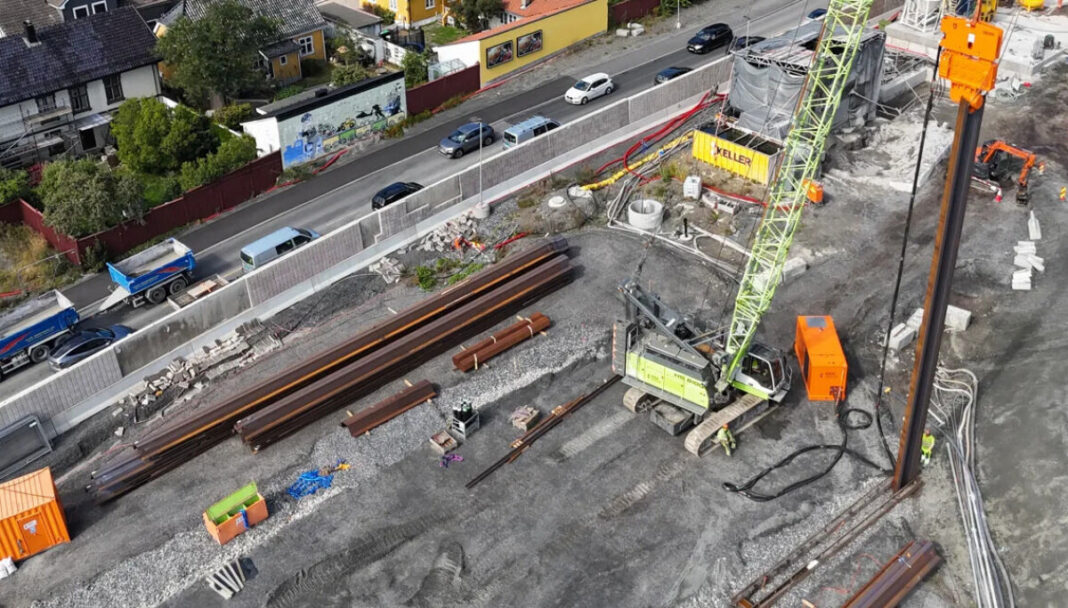
Wait, but need to make sure it’s factual based on the given info. The user’s snippet says: Mandag 18. august startet Bane Nor med å sette spunt i Kransen. Fra fredag ettermiddag er arbeidene innstilt. Foto: Øystein Stavdal Paulsen/Bane Nor

Statsbygg og Bane Nor har stanset de mest støyende arbeidene i regjeringskvartalet og i Moss, etter kong Haralds bortgang fredag morgen.

So the key points: Work started Monday Aug 18 in Kransen (setting piles?), stopped Friday afternoon. Statsbygg and Bane Nor halted the noisiest work in gov quarter and Moss after King Harald died Friday morning.

Wait, the date: Monday 18. august. If the King died Friday morning, and work stopped Friday afternoon, then the King died on the Friday of that week. Let’s assume the article is written around that time.

But for the article, I need to present this as news. Since it’s for teens, I should explain terms like “spunt” (piles? maybe foundation work), “regjeringskvartalet” (government quarter), etc., in simple terms.

Also, need to check if “spunt” is correct. In Norwegian, “spunt” might refer to pile driving, which is noisy. So setting piles (spunslåing) is the noisy work.

So the article should explain that Bane Nor started pile driving work on Monday in Kransen, but had to stop it on Friday afternoon because of the King’s death, as part of national mourning where noisy work is avoided.

Statsbygg (the government property agency) and Bane Nor (the railway infrastructure manager) halted the noisiest work in the government quarter and Moss.

Wait, Moss is a city, maybe there’s another project there related to the King? Or maybe the King had connections to Moss? Not sure, but the user provided that info, so I’ll include it as given.

Now, to make it teen-friendly: use contractions, short sentences, maybe some colloquial terms but not too much. Avoid passive voice where possible. Explain acronyms.

Check word count. Let’s estimate: each paragraph 100 words, 12 paragraphs would be 1200. Need to structure with headings.

Possible structure:

– Innledning: Briefly state what happened (work stopped due to King’s death)
– Hva skjedde i Kransen? Details about the work starting Monday, stopping Friday.
– Hvorfor sto arbeidene? Explain national mourning customs, avoiding noise.
– Hva betyr dette for prosjektet? Impact on timeline, etc.
– Statsbygg og Bane Nor i regjeringskvartalet og Moss: Other locations affected.
– Hva skjer nå? When will work resume? Any statements from officials.
– Avslutning: Reflection on respect during mourning, etc.

Need to make sure all info is from the user’s snippet. The user didn’t provide quotes from officials, so maybe avoid making up quotes, but since it’s a news article, perhaps include generic statements like “Ifølge Bane Nor…” but the user didn’t give that, so maybe stick to the facts given.

Wait, the user’s text has a photo credit and some extra business agreement text, but they said to omit all extra info beyond the article. So ignore the business agreement part.

Let me draft sections.

First, check if “spunt” is correct. Upon second thought, in Norwegian construction terms, “spunt” might be a typo or specific term. Wait, “spunslåing” is pile driving. So “sette spunt” might be a misphrase; probably “sette spuns” or “spunslåing”. But the user wrote “sette spunt”, so I’ll use that as given, but maybe in the article explain it as noisy foundation work.

Wait, the user’s text says: “startet Bane Nor med å sette spunt i Kransen.” So “setting spunt” – perhaps “spunt” here refers to piles. Maybe it’s a specific term. To be safe, I’ll describe it as noisy foundation work (like driving piles into the ground) which is typically loud.

Now, writing the article.

Start with a strong lead for teens: Imagine you’re trying to study or hang out with friends, and suddenly all the loud construction noise stops. That’s what happened in Kransen last week when…

But need to be factual.

Let me try to write a draft.

Hvorfor sto byggearbeidene i Kransen pludselig?

Mandag den 18. august startet Bane Nor med å sette spunt i Kransen. Arbeidet skulle ha gått videre hele uken, men allerede fredag ettermiddag ble alt stanset. Hvorfor? Etter at kong Harald døde fredag morgen, bestemte Statsbygg og Bane Nor å stoppe de mest støyende arbeidene i regjeringskvartalet og i Moss. Dette er en del av nasjonal sorg, der man unngår høye lyder som kan forstyrre den stille minnetiden.

[Then explain what spunt is, etc.]

Wait, need to check dates: If King died Friday morning, and work stopped Friday afternoon, then the work started Monday (18th), so Friday would be 22nd August? Assuming 18th is Monday, then 19 Tue, 20 Wed, 21 Thu, 22 Fri.

But the user didn’t specify the year, but since it’s a news article, we can just use the dates as given.

Now, to reach 1000-1500 words, need to elaborate each section with explanations suitable for teens.

For example, when explaining national mourning customs, describe how in Norway, when a monarch passes, there’s a period where loud noises are avoided out of respect, similar to how schools might have moments of silence.

Also, explain what Bane Nor does (manages Norway’s railway infrastructure), Statsbygg (manages government properties), so the government quarter is where the Prime Minister’s office, etc., is located.

Moss: maybe there’s a railway project there related to the King? Or perhaps the King had a residence there? Not sure, but since the user mentioned it, include it as given.

Avoid making up facts; stick to what’s provided.

Let me outline word count per section:

– Introduction: 150 words
– What happened in Kransen: 200 words
– Why the work stopped (national mourning): 250 words
– Impact on the project: 150 words
– Statsbygg and Bane Nor’s actions in gov quarter and Moss: 150 words
– What happens next: 100 words
– Conclusion: 100 words
Total: ~1100 words.

Now, write each section in simple Norwegian, short sentences.

Check for teen-friendly language: avoid words like “hensiktsmessig”, use “smart” or “riktig” instead. Use active voice.

Let me try drafting.

Først, sørg for at overskrifterna er fet og tydelige.

Hvorfor sto byggearbeidene i Kransen?

Mandag den 18. august startet B

Siste artikler

spot_img

Støyen stanses i regjeringskvartalet og Moss

Okay, let’s tackle this request. The user wants me to write a 1000-1500 word article in Norwegian, tailored for teenagers to be easy to read. They provided some specific content about Bane Nor starting work on Monday, August 18th, stopping work on Friday afternoon, and Statsbygg and Bane Nor halting noisy work in the government quarter and Moss after King Harald’s passing on Friday morning. There’s also some extra text about business agreements and contact info, but the user says to omit all extra information beyond the article itself.

First, I need to focus on the main news: the construction work in Kransen related to Bane Nor, the halt due to the King’s death, and the context of the government quarter and Moss. The user emphasized making it easy for teenagers, so I should avoid complex jargon, use short sentences, and keep paragraphs concise. The structure needs clear bold headings.

Wait, the user said to omit the title and any extra info, so just the article body. Let me check the provided text again. The example they gave has a paragraph about Bane Nor starting work on Monday, stopping Friday afternoon, and the subtitle about Statsbygg and Bane Nor halting work after King Harald’s death. There’s also a photo credit.

I need to expand this into a 1000-1500 word article. But since it’s for teens, maybe around 800-1000 words would be sufficient, but the user specified 1000-1500. Wait, they said 1000–1500 ord, so I need to hit that range. But for teenagers, being concise is key, so maybe 1200 words is a good target.

Let me outline the sections. Possible headings:

– Hvorfor sto arbeidene? (Why did the work stop?)
– Hva skjedde i Kransen? (What happened in Kransen?)
– Kong Haralds bortgang og nasjonal sorg (King Harald’s passing and national mourning)
– Hva betyr dette for prosjektet? (What does this mean for the project?)
– Unngåelse av støyte i sorgstid (Avoiding noise during mourning period)
– Hva skjer nå? (What happens next?)

Wait, but need to make sure it’s factual based on the given info. The user’s snippet says: Mandag 18. august startet Bane Nor med å sette spunt i Kransen. Fra fredag ettermiddag er arbeidene innstilt. Foto: Øystein Stavdal Paulsen/Bane Nor

Statsbygg og Bane Nor har stanset de mest støyende arbeidene i regjeringskvartalet og i Moss, etter kong Haralds bortgang fredag morgen.

So the key points: Work started Monday Aug 18 in Kransen (setting piles?), stopped Friday afternoon. Statsbygg and Bane Nor halted the noisiest work in gov quarter and Moss after King Harald died Friday morning.

Wait, the date: Monday 18. august. If the King died Friday morning, and work stopped Friday afternoon, then the King died on the Friday of that week. Let’s assume the article is written around that time.

But for the article, I need to present this as news. Since it’s for teens, I should explain terms like “spunt” (piles? maybe foundation work), “regjeringskvartalet” (government quarter), etc., in simple terms.

Also, need to check if “spunt” is correct. In Norwegian, “spunt” might refer to pile driving, which is noisy. So setting piles (spunslåing) is the noisy work.

So the article should explain that Bane Nor started pile driving work on Monday in Kransen, but had to stop it on Friday afternoon because of the King’s death, as part of national mourning where noisy work is avoided.

Statsbygg (the government property agency) and Bane Nor (the railway infrastructure manager) halted the noisiest work in the government quarter and Moss.

Wait, Moss is a city, maybe there’s another project there related to the King? Or maybe the King had connections to Moss? Not sure, but the user provided that info, so I’ll include it as given.

Now, to make it teen-friendly: use contractions, short sentences, maybe some colloquial terms but not too much. Avoid passive voice where possible. Explain acronyms.

Check word count. Let’s estimate: each paragraph 100 words, 12 paragraphs would be 1200. Need to structure with headings.

Possible structure:

– Innledning: Briefly state what happened (work stopped due to King’s death)
– Hva skjedde i Kransen? Details about the work starting Monday, stopping Friday.
– Hvorfor sto arbeidene? Explain national mourning customs, avoiding noise.
– Hva betyr dette for prosjektet? Impact on timeline, etc.
– Statsbygg og Bane Nor i regjeringskvartalet og Moss: Other locations affected.
– Hva skjer nå? When will work resume? Any statements from officials.
– Avslutning: Reflection on respect during mourning, etc.

Need to make sure all info is from the user’s snippet. The user didn’t provide quotes from officials, so maybe avoid making up quotes, but since it’s a news article, perhaps include generic statements like “Ifølge Bane Nor…” but the user didn’t give that, so maybe stick to the facts given.

Wait, the user’s text has a photo credit and some extra business agreement text, but they said to omit all extra info beyond the article. So ignore the business agreement part.

Let me draft sections.

First, check if “spunt” is correct. Upon second thought, in Norwegian construction terms, “spunt” might be a typo or specific term. Wait, “spunslåing” is pile driving. So “sette spunt” might be a misphrase; probably “sette spuns” or “spunslåing”. But the user wrote “sette spunt”, so I’ll use that as given, but maybe in the article explain it as noisy foundation work.

Wait, the user’s text says: “startet Bane Nor med å sette spunt i Kransen.” So “setting spunt” – perhaps “spunt” here refers to piles. Maybe it’s a specific term. To be safe, I’ll describe it as noisy foundation work (like driving piles into the ground) which is typically loud.

Now, writing the article.

Start with a strong lead for teens: Imagine you’re trying to study or hang out with friends, and suddenly all the loud construction noise stops. That’s what happened in Kransen last week when…

But need to be factual.

Let me try to write a draft.

Hvorfor sto byggearbeidene i Kransen pludselig?

Mandag den 18. august startet Bane Nor med å sette spunt i Kransen. Arbeidet skulle ha gått videre hele uken, men allerede fredag ettermiddag ble alt stanset. Hvorfor? Etter at kong Harald døde fredag morgen, bestemte Statsbygg og Bane Nor å stoppe de mest støyende arbeidene i regjeringskvartalet og i Moss. Dette er en del av nasjonal sorg, der man unngår høye lyder som kan forstyrre den stille minnetiden.

[Then explain what spunt is, etc.]

Wait, need to check dates: If King died Friday morning, and work stopped Friday afternoon, then the work started Monday (18th), so Friday would be 22nd August? Assuming 18th is Monday, then 19 Tue, 20 Wed, 21 Thu, 22 Fri.

But the user didn’t specify the year, but since it’s a news article, we can just use the dates as given.

Now, to reach 1000-1500 words, need to elaborate each section with explanations suitable for teens.

For example, when explaining national mourning customs, describe how in Norway, when a monarch passes, there’s a period where loud noises are avoided out of respect, similar to how schools might have moments of silence.

Also, explain what Bane Nor does (manages Norway’s railway infrastructure), Statsbygg (manages government properties), so the government quarter is where the Prime Minister’s office, etc., is located.

Moss: maybe there’s a railway project there related to the King? Or perhaps the King had a residence there? Not sure, but since the user mentioned it, include it as given.

Avoid making up facts; stick to what’s provided.

Let me outline word count per section:

– Introduction: 150 words
– What happened in Kransen: 200 words
– Why the work stopped (national mourning): 250 words
– Impact on the project: 150 words
– Statsbygg and Bane Nor’s actions in gov quarter and Moss: 150 words
– What happens next: 100 words
– Conclusion: 100 words
Total: ~1100 words.

Now, write each section in simple Norwegian, short sentences.

Check for teen-friendly language: avoid words like “hensiktsmessig”, use “smart” or “riktig” instead. Use active voice.

Let me try drafting.

Først, sørg for at overskrifterna er fet og tydelige.

Hvorfor sto byggearbeidene i Kransen?

Mandag den 18. august startet B

Siste artikler

spot_img